

Most Powerful Way of Understanding Lead Generation in Real Estate
WHY TRADITIONAL REAL ESTATE LEAD GENERATION ADVICE OFTEN FAILS NEW AGENTS
If you’re a new real estate agent trying to figure out how to get clients, you’ve probably discovered that there’s no shortage of advice about lead generation. Your broker may recommend cold calling or door knocking. Another agent insists that hosting open houses is the fastest way to find buyers. Someone else tells you to post on social media every day, attend networking events, send postcards, or buy leads from an online advertising company. Before long, you’ve collected dozens of suggestions, but you still don’t have a clear idea of which activities you should actually be doing.
That’s one of the biggest problems with the way real estate agents are traditionally taught lead generation. Most training focuses on individual marketing activities without first helping you determine whether those activities are appropriate for your local market, your target clients, or your personality. You’re encouraged to start doing things immediately, often without understanding whether those efforts have a reasonable chance of producing the business you need.
After more than 17 years in real estate, and with a professional background in marketing and corporate training, I’ve come to believe there’s a much better way to approach this important part of your business. Instead of starting with a list of activities, you should begin by understanding your local real estate market, identifying a profitable target market, and choosing a marketing strategy that can effectively reach those prospective clients. Then you can select specific marketing activities that fit your personality, strengths, schedule, and budget.
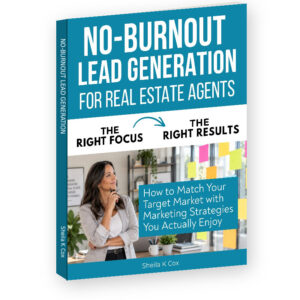
That’s the foundation of my NO-BURNOUT LEAD GENERATION FOR REAL ESTATE AGENTS method. It’s designed to help you stop guessing about which marketing activities to try and start making informed decisions about how to attract clients and build a real estate business you actually enjoy.
THE PROBLEM WITH THE STANDARD APPROACH TO REAL ESTATE LEAD GENERATION
Too many lead generation options
There are probably more than 100 individual activities, or tactics, that real estate agents can use to generate leads. As you read books about lead generation, attend broker training classes, watch webinars, and listen to successful agents explain how they built their businesses, you’ll be presented with an enormous variety of ideas. Some involve contacting people directly, while others focus on advertising, relationship building, community involvement, or online marketing. Each approach has its advocates, and many of them can be effective under the right circumstances.

I remember sitting down one day early in my real estate career and reviewing a list of approximately 100 different lead generation ideas. As I worked my way through the list, I remember thinking, “Well, I can’t do ALL of these, so which ones should I try?” It was obvious that I couldn’t possibly implement every suggestion, especially while learning contracts, understanding my local market, and developing all the other skills required to become a competent real estate agent.
Looking at a list of 100 different marketing activities is overwhelming because there’s no obvious way to evaluate them. How do you know which activities will reach the clients you want? Which ones can you afford? Which ones require skills you haven’t developed yet? And which ones will you actually enjoy doing consistently? Without some way to organize and compare your options, you’re essentially being asked to make important business decisions without enough information.
That’s one of the reasons I developed the No-Burnout Method. I organized those many individual lead generation tactics into four primary marketing strategies so agents could understand the different approaches available without becoming overwhelmed by an endless list of activities. But organizing the options is only the beginning. You still need a process for determining which strategies and tactics make sense for your particular business.
No well-thought-out marketing plan
To make matters worse, every real estate agent you meet and every training session you attend seems to recommend something different, often without explaining why that particular approach should work for you. One successful agent tells you to make 50 phone calls every morning. Another says you should spend your weekends hosting open houses. Someone else insists that social media is the future of real estate marketing. When you’re newly licensed, it’s difficult to evaluate this advice because you haven’t yet developed enough experience to know which activities are appropriate for your circumstances.
So you start trying things. You host an open house one weekend and get no qualified leads. The following week, you try door knocking, discover that you hate approaching strangers at their homes, and get no leads. Then you send a letter to everyone you know announcing your new real estate career, but nobody calls. After that, you post on Instagram every day for a week, hoping someone will contact you about buying or selling a home. Again, nothing happens.
After several weeks of this, you begin wondering whether you’re doing something wrong. Other agents seem to be finding clients, so why aren’t your efforts producing results? You may start questioning your abilities, your motivation, or even your decision to enter the real estate industry. Meanwhile, you’ve invested considerable time and energy in activities that haven’t produced any meaningful business opportunities.
The problem is that you’re using what I call the “shotgun approach” to lead generation. You’re trying one activity after another, hoping something will eventually work, without a clear understanding of your target market or an organized marketing strategy. Some of those activities may be perfectly effective when they’re part of a coordinated marketing system, but isolated attempts rarely provide enough information to determine whether a particular approach is worth pursuing.
That’s not how successful companies approach marketing, and it’s not how I believe you should approach your real estate business. Businesses typically begin by understanding their markets, identifying the customers they want to attract, and developing strategies designed to reach those customers. They don’t simply choose random advertising activities and hope for the best. As a real estate agent running your own business, you should apply the same fundamental marketing principles.
Wrong choices can lead to avoidance and burnout
Another problem occurs when hardworking, well-meaning agents commit to a particular lead generation tactic without considering whether it makes sense for their local market or their personality. They may follow the advice of a successful trainer, invest substantial time and money, and faithfully complete the recommended activities. Unfortunately, even consistent effort can’t overcome every problem caused by choosing an unsuitable market or an approach that doesn’t fit the agent.
For example, some real estate trainers promote systems built around contacting For Sale By Owner (FSBO) homeowners. If I had followed that approach in my own market area, I would have struggled because there simply wasn’t enough FSBO activity to support the kind of business I wanted to build. The problem wouldn’t have been that contacting FSBO sellers is inherently ineffective. It would have been that I was concentrating my efforts on a niche market with too few opportunities.
This is why understanding your local real estate market is so important. A lead generation strategy that works extremely well in one city may be a poor choice in another. You need to know whether the prospective clients you’re trying to attract actually exist in sufficient numbers and whether there’s a reasonable opportunity to earn their business. Otherwise, you can waste months pursuing a niche that isn’t viable in your particular market.
Now consider an agent who decides to make hosting open houses his primary lead generation activity. He spends two months arranging open houses through other agents in his brokerage and faithfully hosts them every weekend. He meets a few prospective buyers, but he absolutely hates spending his weekends sitting in vacant houses and making conversation with strangers. Eventually, he starts finding excuses not to schedule another open house. After three months, he abandons the activity altogether.
In this situation, open houses didn’t necessarily fail as a lead generation tactic. The agent simply chose an activity that was a poor fit for his personality and preferences. Even if it had generated some promising leads, he probably wouldn’t have continued doing it long enough to build a sustainable business. He became frustrated and began avoiding the very activity he’d selected to generate clients.
That’s the kind of burnout I want to help you avoid. When you build your entire marketing system around activities you dislike, staying consistent becomes an ongoing struggle. You may force yourself to complete those tasks for a while, but eventually your resistance can undermine your efforts. A better approach is to choose activities that reach the right prospective clients while taking advantage of your natural strengths and interests.
INTRODUCING A BETTER WAY: THE NO-BURNOUT LEAD GENERATION METHOD
When I began developing my No-Burnout Lead Generation Method, I drew on my formal marketing education and professional training experience. I remembered studying fundamental marketing principles, including the Four Ps of marketing and the importance of identifying the right target market before deciding how to promote a product or service. Those principles apply just as much to a solo real estate agent as they do to a large corporation.
Yet much of the lead generation advice given to new real estate agents skips over those foundational decisions. Instead of helping you analyze your market and choose an appropriate audience, it jumps straight into telling you which activities to perform. I wanted to create a more organized approach that would help agents understand not only what marketing options were available, but also how to determine which options were most likely to work for them.
The No-Burnout Method follows a deliberate sequence. First, you develop a better understanding of your local real estate market. Next, you evaluate potential target markets and identify one that offers a realistic opportunity to achieve your income goals. Then you choose a marketing strategy capable of reaching that audience. Finally, you select specific marketing tactics that fit your personality, strengths, available time, and budget.
When you make those decisions in the right order, you can develop a lead generation system that is much more focused than simply trying whatever marketing idea sounds promising that week. You’ll understand whom you’re trying to attract, why you’ve chosen a particular strategy, and how your daily activities contribute to your business goals. Just as importantly, you’ll be choosing activities you can enjoy enough to perform consistently without burning out.
STEP 1: UNDERSTAND YOUR LOCAL REAL ESTATE MARKET
Before you choose a target market or decide how you’re going to generate leads, you need to understand the real estate market where you intend to work. This is one of the most important steps in the entire process because your local market determines which business opportunities are actually available to you. You can have an excellent marketing strategy and work incredibly hard, but if you’re targeting a group of prospective clients that barely exists in your market, you’re going to struggle.
Understanding your market involves more than knowing the average home price or reading a monthly market report. You need to develop a broader picture of local real estate activity, including where homes are selling, which price ranges have meaningful transaction volume, what types of properties are available, and how market conditions differ across neighborhoods and communities. You also need to understand the competitive environment and recognize that some markets may be much more difficult to penetrate than others.
For example, you might assume that luxury homes would be an attractive target because they offer the potential for larger commissions. However, if relatively few luxury properties sell in your area each year, or if a handful of established agents already represent most of those transactions, breaking into that market may be more challenging than you expect. Meanwhile, another segment of your local market may offer more frequent transactions and a greater number of potential clients.
The point isn’t that you should automatically choose the busiest market or avoid competitive areas. It’s that you need enough information to evaluate your opportunities intelligently. When you understand the market before making marketing decisions, you’re much less likely to invest your limited time and money pursuing opportunities that aren’t a good fit for your business.
In NO-BURNOUT LEAD GENERATION FOR REAL ESTATE AGENTS, I explain how to analyze your local real estate market and organize the information you need to make these decisions. Instead of relying on assumptions about where the best opportunities might be, you’ll have a process for evaluating your market using real data.
STEP 2: CHOOSE A PROFITABLE TARGET MARKET
Once you understand your local housing market, the next step is to identify a specific group of buyers or sellers you want to attract. This is your target market, and choosing it carefully is one of the most important business decisions you’ll make. Your target market influences your branding, your marketing message, the services you emphasize, and the strategies you’ll use to find prospective clients.
Many agents choose a target market based primarily on personal interests or convenience. They decide to farm the neighborhood where they live, specialize in a particular property type because they enjoy looking at those homes, or focus on a group of clients they feel comfortable working with. There’s nothing wrong with considering your preferences, but those factors alone don’t tell you whether the market can support your financial goals.
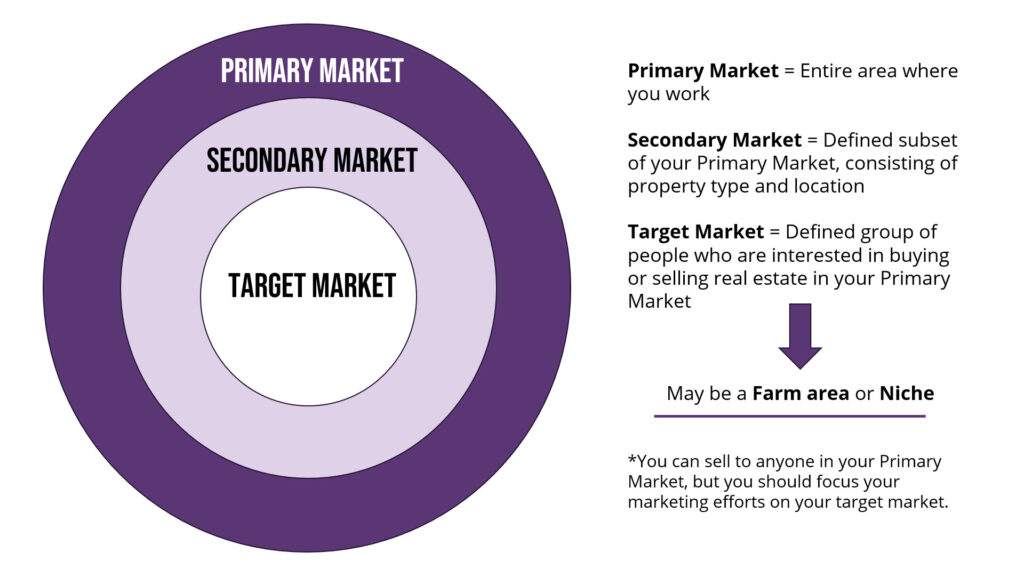 Suppose you want to close 15 transactions per year and you’re considering farming a neighborhood that averages only 10 home sales annually. Even if you somehow represented every seller in that neighborhood, you still wouldn’t generate enough transactions to meet your goal. In reality, you’d be competing with other agents for a limited number of opportunities, making your potential market share considerably smaller.
Or perhaps you’re interested in specializing in a particular niche because you’ve heard that those clients can be profitable. Before building your marketing around that niche, you need to understand how many potential transactions occur in your area, what those transactions might be worth, how much competition exists, and whether you can realistically reach the prospective clients involved.
These are the kinds of questions that should be answered before you commit to a marketing campaign. Choosing a profitable target market isn’t simply about identifying people who might someday need a real estate agent. It’s about evaluating whether that audience offers enough realistic business opportunities to justify the time, money, and effort required to attract them.
My No-Burnout guide includes market analysis and target market evaluation worksheets to help you compare opportunities and make a more informed decision. This is a step I strongly recommend taking seriously because choosing the wrong target market can undermine even a well-executed marketing campaign.
STEP 3: MATCH YOUR TARGET MARKET TO THE RIGHT MARKETING STRATEGY
After you’ve identified a profitable target market, you’re finally ready to decide how you’re going to reach those prospective clients. Notice that you’re not beginning with your favorite marketing activity or copying the routine of a successful agent. You’re starting with a specific audience and choosing a marketing strategy based on how you can most effectively connect with that audience.
Different target markets require different approaches. A marketing system designed to attract relocating buyers who are researching communities online may be very different from one intended to build name recognition among homeowners in a particular neighborhood. Likewise, developing relationships with local business owners requires different activities from reaching prospective sellers who are actively researching their home’s value.
In my No-Burnout Method, I organize most of the individual lead generation tactics into four primary marketing strategies. This makes it much easier to understand the different approaches available and evaluate which ones are appropriate for your target market. Rather than attempting to implement dozens of unrelated activities, you can concentrate on one or two strategies that make sense for the clients you want to attract.
You don’t need to use every marketing strategy to become successful in real estate. In fact, I generally recommend that newer agents concentrate on developing a manageable number of effective systems before expanding their marketing efforts. It’s better to implement one or two well-chosen strategies consistently than to spread your time and budget across several approaches without becoming proficient at any of them.
The important distinction is that your marketing strategy should be selected because it offers an effective way to reach your target market—not simply because someone else has had success with it. My guide walks you through evaluating the four strategies and determining which approach, or combination of approaches, is best suited to the business you’re trying to build.
STEP 4: CHOOSE LEAD GENERATION TACTICS THAT MATCH YOUR PERSONALITY
Once you’ve selected a marketing strategy, you still need to decide which specific activities you’ll use to implement it. This is where your personality, natural strengths, and preferences become especially important. Two agents may target the same market and choose the same overall marketing strategy, yet use very different tactics because they have different skills and enjoy different types of work.
For example, some agents genuinely enjoy meeting strangers, starting conversations, and participating in large social gatherings. Others prefer one-on-one conversations or developing relationships gradually. Some agents enjoy writing, research, technology, and creating educational resources, while others would rather spend their time interacting directly with people. These differences can have a major influence on which marketing activities you’re willing to perform consistently.
I believe this is one of the most overlooked aspects of real estate lead generation training. Too often, agents are told to follow a particular routine without considering whether the activities are a reasonable fit for their personalities. An agent who dislikes cold calling may be encouraged to make dozens of calls every day, while someone who hates creating social media content may be told that daily posting is essential. Those approaches might work for other agents, but that doesn’t mean they’re the best choices for you.
Of course, building a real estate business requires effort, and you shouldn’t expect every activity to be easy or enjoyable. You’ll need to develop new skills, handle uncomfortable situations, and occasionally work outside your comfort zone. However, there’s a significant difference between learning a necessary professional skill and deliberately building your entire marketing system around activities you dread.
When you choose tactics that fit your personality and strengths, you’re more likely to approach your marketing with enthusiasm instead of resistance. That makes it easier to develop consistent habits, which are essential for long-term lead generation. My No-Burnout guide includes personality-based comparisons to help you identify marketing activities that may be a better fit for the way you naturally prefer to work.
WHEN YOUR TARGET MARKET, MARKETING STRATEGY, AND PERSONALITY ALIGN
Here’s where the No-Burnout Method comes together. You’ve analyzed your local real estate market and selected a target audience with worthwhile business opportunities. You’ve chosen a marketing strategy designed to reach that audience effectively. And you’ve identified specific activities that fit your personality, strengths, available time, and budget.
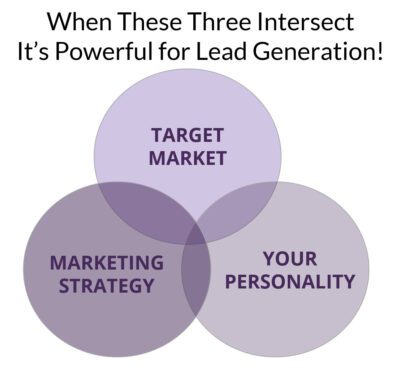
When these three elements align, you have the foundation for a lead generation system that’s much more focused and sustainable than the shotgun approach. You’re no longer jumping from one marketing idea to another, hoping something will work. Instead, you’re following a plan based on a specific market opportunity and a carefully selected approach to reaching prospective clients.
Just as importantly, you’ve chosen activities that you can enjoy enough to perform consistently. Rather than forcing yourself through a daily routine you dread, you can spend more of your marketing time doing work that fits your strengths and interests. That doesn’t eliminate the effort required to generate leads, but it can make the process considerably more satisfying and easier to maintain over time.
Think about how different your workday could feel when you understand exactly whom you’re trying to attract, why you’ve chosen your marketing strategy, and how your daily activities contribute to your business goals. Instead of feeling overwhelmed by an endless list of things you should be doing, you can concentrate on a manageable set of activities that work together as part of an organized marketing system.
That’s what I mean by No-Burnout Lead Generation. The goal isn’t to avoid working hard or to suggest that marketing should always be easy. It’s to help you build a real estate business around informed marketing decisions and activities you can sustain without constantly fighting your own personality.
STOP GUESSING ABOUT HOW TO GENERATE REAL ESTATE LEADS
If you’re frustrated with traditional real estate lead generation advice, I want you to consider whether you’ve been approaching the problem in the wrong order. Perhaps you’ve been trying to decide which activities to perform before identifying the market you want to reach. Or maybe you’ve chosen a strategy because another agent recommended it, without evaluating whether it makes sense for your circumstances. You may even be spending hours on activities you dislike because you’ve been told they’re necessary for success.
My NO-BURNOUT LEAD GENERATION FOR REAL ESTATE AGENTS guide was created to help you replace that uncertainty with a structured decision-making process. Rather than presenting another overwhelming collection of marketing ideas, it walks you through understanding your local market, evaluating profitable target markets, choosing suitable marketing strategies, and selecting activities that match your personality and resources.
The guide includes detailed explanations, real-world examples, worksheets, and templates to help you make these decisions and develop a marketing plan you can actually implement. You’ll also learn how to establish the supporting systems needed to organize your contacts, maintain relationships, follow up with leads, and track your marketing results. Instead of simply knowing that you should be generating leads, you’ll have a clearer understanding of how to build a lead generation system that fits your business.
You don’t have to become a cold-calling expert, attend every networking event, or spend your life creating social media posts to succeed in real estate. You need to find a profitable target market, select an effective way to reach those prospective clients, and choose marketing activities that you can perform consistently. When those decisions work together, you’re in a much better position to build a sustainable business—and enjoy the process.
Explore the printed NO-BURNOUT LEAD GENERATION FOR REAL ESTATE AGENTS guide and its separately available digital toolkit in the Agent Success Builder Shop.
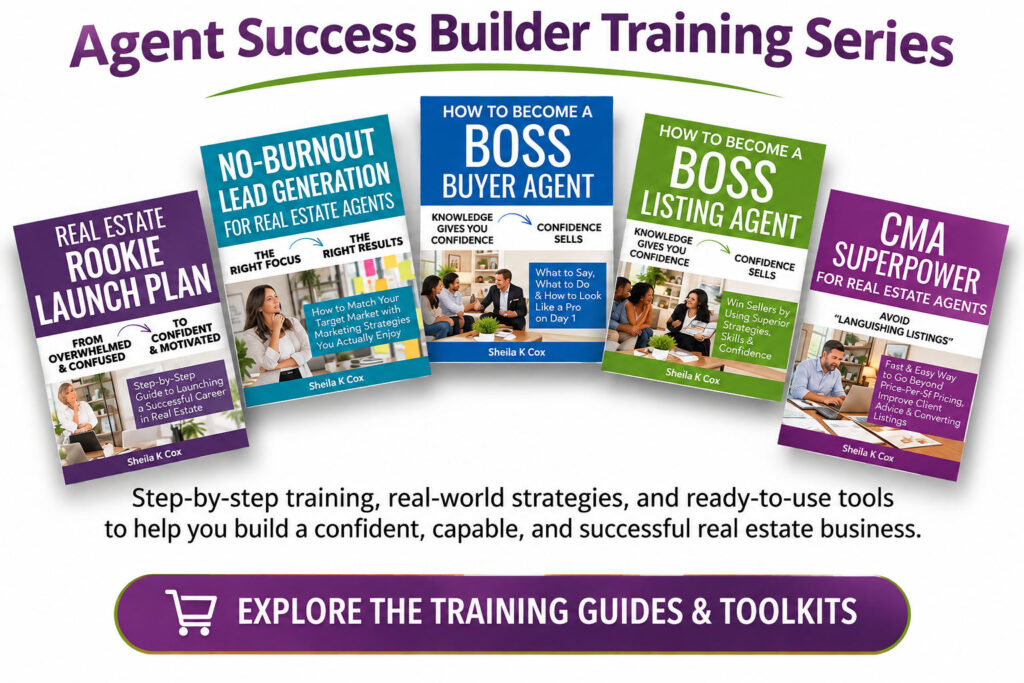
Ready to take your real estate career to the next level? Whether you’re just getting started or looking to strengthen your skills, the Agent Success Builder Training Series gives you the real-world knowledge, step-by-step guidance, and ready-to-use tools you need to build a successful real estate business.
Stop wasting time trying to figure everything out on your own. Explore our Training Guides and Digital Toolkits and find the resources that will help you become a more confident, capable, and successful real estate agent.