

Step-by-Step Process for Choosing a Profitable Target Market–From Guesswork to Paycheck
HOW TO FIND A PROFITABLE TARGET MARKET IN REAL ESTATE
One of the most important decisions you’ll make as a real estate agent is choosing which buyers and sellers you want to attract. Your target market influences almost everything about your business, including your marketing strategy, advertising expenses, professional expertise, and ultimately, your ability to generate enough clients to meet your income goals.
Unfortunately, many new real estate agents don’t give this decision nearly enough attention. They choose a neighborhood because it’s close to home, decide to specialize in a particular type of property because they like it, or simply announce that they’ll help anyone who wants to buy or sell real estate. Then they spend months trying different lead generation activities without understanding whether they’re reaching a market that offers enough business opportunities.
I’ve seen how easy it is for agents to confuse working hard with working toward a profitable opportunity. You can spend hours creating marketing materials, hosting open houses, attending events, and contacting prospective clients. But if the market you’ve chosen doesn’t have enough transactions, or if you can’t realistically compete for those transactions, your marketing efforts may never produce the income you need.
That’s why choosing a profitable target market is one of the foundational steps in my NO-BURNOUT LEAD GENERATION FOR REAL ESTATE AGENTS method. Before you decide how you’re going to attract clients, you need to understand which clients represent worthwhile opportunities in your local real estate market.
WHY YOUR TARGET MARKET MATTERS MORE THAN YOU THINK

Think about how most businesses approach marketing. They don’t usually begin by deciding which advertisements to run or which social media platforms to use. First, they identify the customers they want to attract, evaluate the demand for their products or services, and consider how they can compete effectively. Only then do they develop marketing strategies designed to reach those customers.
Real estate agents should follow the same fundamental principles. Yet new agents are frequently encouraged to start generating leads immediately, before they’ve developed a clear understanding of their local market. They may be told to farm a neighborhood, contact homeowners, or target a particular type of buyer without first evaluating whether that market offers enough opportunities to support their business.
For example, imagine you’ve decided to specialize in a neighborhood you love. You know the streets, enjoy the amenities, and think it would be convenient to work there. You spend money on postcards, create neighborhood content, and introduce yourself to homeowners. After several months, you haven’t generated a single listing appointment, and you’re wondering why your marketing isn’t working.
What if the neighborhood has very little turnover? What if only a handful of homes sell there each year, and several established agents already have strong relationships with the homeowners? Your marketing activities may not be the primary problem. You may have chosen a target market that offers too few realistic opportunities.
This is why I strongly recommend evaluating your target market before committing substantial time and money to marketing. Choosing the right market won’t guarantee that you’ll succeed, but choosing the wrong one can make success unnecessarily difficult.
UNDERSTAND YOUR LOCAL REAL ESTATE MARKET BEFORE CHOOSING A NICHE
Real estate is a local business, and every market has its own characteristics. The types of properties available, price ranges, transaction activity, competition, and buyer demographics can vary dramatically from one city to another—and even between neighborhoods within the same city.

For example, an agent working in a major metropolitan area might have opportunities to specialize in luxury high-rise condominiums, suburban single-family homes, townhomes, or investment properties. An agent working in a rural community may encounter an entirely different mix of properties, including country homes, acreage, farms, and ranches. Even within the same metropolitan area, the housing market in one ZIP Code may be very different from the market just a few miles away.
These differences matter because they influence which clients you can realistically attract and which marketing strategies are likely to reach them. A real estate agent specializing in downtown condominiums will need different market knowledge and marketing messages than an agent serving buyers looking for homes with acreage. The same is true for an agent targeting first-time buyers compared with one serving homeowners preparing to sell luxury properties.
Before choosing a target market, you should develop a broad understanding of the area where you intend to work. Which types of properties are common? Where are transactions taking place? What price ranges are active? Are there neighborhoods or property categories that offer opportunities you haven’t considered?
Answering these questions can help you avoid making assumptions about your market and reveal potential opportunities that deserve further investigation.
YOUR MLS IS ONE OF YOUR MOST VALUABLE BUSINESS TOOLS
One of the greatest advantages you have as a licensed real estate agent is access to your Multiple Listing Service (MLS). While consumers can find considerable information about homes online, your MLS provides professional tools and detailed listing and transaction data that can help you understand your local housing market.
Unfortunately, many new agents learn just enough about their MLS to search for homes and schedule showings. They may become comfortable finding listings for buyers but never fully explore the market research and statistical capabilities available through their system. That’s a missed opportunity because your MLS can help you make better decisions about where to focus your business.
Depending on your MLS, you may be able to examine transaction activity across different cities, ZIP Codes, subdivisions, and property types. You can also investigate pricing trends, marketing times, available inventory, and other indicators that provide insight into local market conditions. The exact tools and reports vary by MLS, but the underlying information can be extremely valuable.
I recommend taking both the basic and advanced MLS training classes offered through your local association or MLS provider. Don’t limit your education to learning how to find listings for clients. Become comfortable researching market activity and interpreting the information you find. These skills will help you identify potential target markets, develop your hyperlocal expertise, and eventually provide better advice to buyers and sellers.
In my NO-BURNOUT LEAD GENERATION FOR REAL ESTATE AGENTS guide, I explain how to use MLS market information to evaluate potential business opportunities. The accompanying worksheets help you organize your findings and compare different markets without having to develop your own analysis process from scratch.
NOT ALL REAL ESTATE MARKETS OFFER THE SAME OPPORTUNITIES
One of the most important things to understand about real estate is that a market can look attractive without necessarily being profitable for your business. Beautiful homes, high property values, and desirable neighborhoods don’t automatically translate into enough opportunities for you to generate a reliable income.
Consider two neighborhoods. The first has expensive homes, attractive amenities, and an excellent reputation, but only a small number of properties sell each year. The second has more moderately priced homes and considerably more annual transactions. Which neighborhood offers the better opportunity for a new agent?
The answer isn’t necessarily the neighborhood with the highest home prices. You also need to consider the number of potential transactions, the commission income associated with those transactions, the level of competition, and the cost of reaching prospective clients. A market with lower-priced homes but more frequent sales may provide greater opportunities than an exclusive neighborhood where very few properties change hands.

Another important consideration is how realistic it will be for you to earn business in that market. A neighborhood may have substantial sales activity, but if several established agents already dominate the listings, you’ll need to think carefully about how you can differentiate yourself. Competition doesn’t necessarily mean you should avoid an area, but it should influence your expectations and marketing decisions.
Likewise, you should consider the costs associated with attracting and serving clients in a particular market. Some target markets are relatively easy to reach through existing relationships, while others may require ongoing advertising expenses or considerable time to establish credibility. The amount of business available matters, but so does the investment required to earn that business.
This is why I encourage agents to look beyond surface-level impressions and evaluate potential target markets using real market information. You want to identify opportunities that make sense financially, not simply places where you’d enjoy showing homes.
GEOGRAPHIC TARGET MARKETS VS. NICHE MARKETS
When deciding whom you want to attract, you generally have two broad approaches to consider. You can focus on a particular geographic area, or you can specialize in a specific type of property or client. Both approaches can be effective, but they offer different opportunities and require different considerations.
Geographic target markets
A geographic target market is defined primarily by location. You might focus on several neighborhoods within a city, a particular ZIP Code, a master-planned community, or a condominium building. The objective is to develop expertise and recognition within a defined area rather than trying to market your services across an entire metropolitan region.
For example, an agent might concentrate on several active neighborhoods in a suburban community. By developing detailed knowledge of those neighborhoods, the agent can become a valuable resource for buyers and sellers who want information about local housing options, market conditions, and community characteristics.
A smaller geographic area can also be easier to market consistently because your advertising and community involvement can be concentrated on a more manageable audience. However, a small market isn’t automatically a good market. It still needs enough transaction activity and potential clients to justify your investment.
Niche target markets
A niche market focuses on a particular type of client, property, or real estate need. Examples include first-time homebuyers, relocation clients, investors, luxury homes, waterfront properties, golf course homes, and country homes with acreage. Rather than concentrating exclusively on one neighborhood, you may serve clients with similar needs across a larger geographic area.
One advantage of niche marketing is that it allows you to develop specialized knowledge and tailor your marketing message to a clearly defined audience. If you’re genuinely interested in a particular type of property or enjoy working with a certain group of clients, that interest can also make your work more satisfying.
However, personal enthusiasm isn’t enough to make a niche profitable. If you love golf and want to specialize in golf course homes, you first need to determine whether enough of those properties exist and sell in your market. If you’re interested in helping first-time homebuyers, you need to understand whether your local housing market offers properties those buyers can realistically afford.
Some niches can be evaluated using property information available through your MLS, while others require additional research because they’re defined by client characteristics rather than listing data. Either way, you need to establish that your preferred niche represents a realistic business opportunity before investing heavily in marketing.
SHOULD YOU FARM A NEIGHBORHOOD?
Geographic farming is a popular real estate marketing approach because it allows you to concentrate on becoming known within a specific neighborhood or community. Rather than trying to compete throughout an entire city, you focus your marketing efforts on a smaller area where you can develop visibility, relationships, and local expertise.

However, not every neighborhood makes a good farm area. Some have very little turnover, while others are so large that reaching homeowners consistently would require a substantial advertising budget. You may also encounter neighborhoods where a few established agents already have a significant presence, making it more difficult to gain recognition and earn listing opportunities.
Before choosing a farm area, consider whether the neighborhood offers enough potential transactions to support your business goals and whether you can afford to market there consistently. You should also think about how much competition exists and whether you have a genuine interest in becoming knowledgeable about that community.
For example, you might love a large master-planned community with thousands of homes. It could offer substantial annual sales activity, but reaching every homeowner through direct mail may be financially unrealistic for a new agent. On the other hand, a smaller neighborhood might be easier to reach but have too few transactions to justify making it your primary source of business.
These are the kinds of tradeoffs you need to evaluate before committing to a Farming strategy. The goal isn’t simply to find a neighborhood you like. It’s to identify a market where you have a reasonable opportunity to build recognition, attract clients, and earn enough business to justify your marketing efforts.
CAN YOUR TARGET MARKET SUPPORT YOUR INCOME GOALS?
Here’s a question I believe every new real estate agent should ask before selecting a target market: Does this market offer enough potential business to support the income I want to earn?
Let’s say your goal is to close 15 transactions per year, and you’re considering focusing on a neighborhood where only 10 homes sell annually. Even if you somehow represented every seller in that neighborhood, you still wouldn’t reach your transaction goal from those listings alone. In reality, you’ll be competing with other agents, so your potential share of those transactions will be considerably smaller.
That doesn’t mean you can’t work in the neighborhood or include it as part of a larger target market. It simply means that relying on that neighborhood as your primary source of business may not be realistic. You might need to expand your geographic focus, combine several neighborhoods, or consider a different target market altogether.
Now consider the opposite situation. You identify a large market with hundreds of annual transactions, but reaching those prospective clients would require advertising expenses far beyond your budget. Even though the market has substantial activity, it may not be an appropriate choice for your business at this stage.
A profitable target market needs to offer a reasonable balance between opportunity and accessibility. You want enough potential transactions to support your goals, but you also need a realistic way to compete for those clients without exhausting your resources.
In my No-Burnout guide, I provide a structured process for evaluating potential target markets against your business goals. Instead of guessing whether a market is large enough or assuming that a desirable neighborhood will be profitable, you can use market information to make a more informed decision.
CHOOSE A TARGET MARKET THAT’S ALSO A GOOD MATCH FOR YOU
Financial opportunity is essential, but it’s not the only consideration when selecting a target market. You also need to think about whether you’ll enjoy working with the clients and properties associated with that market, whether you can develop the expertise those clients expect, and whether you have a realistic way to establish credibility with them.
For example, if you love researching neighborhoods and helping families compare communities, you might enjoy working with relocation buyers. If you’re passionate about historic architecture, you may be drawn to established neighborhoods with older homes. If you have professional experience in construction or investing, that background may provide useful knowledge when serving clients with related real estate needs.
These interests and experiences can help you differentiate yourself, but they should complement—not replace—your market analysis. A niche that aligns with your interests may be enjoyable, but it still needs enough viable business opportunities. Likewise, a profitable market may not be the best long-term choice if you dislike the work involved in serving those clients.
You should also consider the knowledge and communication skills required to serve your chosen market effectively. Different clients have different priorities, expectations, and concerns. Understanding those needs and developing the appropriate expertise will help you communicate your value and build trust.
Ultimately, the strongest target market is one that offers worthwhile business opportunities and is a good fit for your interests, capabilities, and professional goals. That’s an important part of developing a real estate business you can enjoy building over time.
YOUR TARGET MARKET SHOULD GUIDE YOUR LEAD GENERATION STRATEGY
Once you’ve identified a profitable target market, you’re ready to make another important decision: how you’re going to reach those prospective clients. This is where your market research begins to influence your actual marketing activities.
Different target markets may require different approaches. An agent targeting relocating buyers who research communities online may need a different marketing strategy from an agent trying to build recognition among homeowners in a particular neighborhood. Likewise, an agent serving a specialized niche may need to reach prospective clients through different channels than someone concentrating on a geographic farm area.
This is why I don’t recommend choosing your lead generation activities before you’ve selected your target market. If you start with an activity simply because another agent recommends it, you may discover that it doesn’t effectively reach the people you want to attract. You could be working consistently and spending money without making meaningful progress toward your business goals.
In my No-Burnout Method, I organize more than 100 individual lead generation tactics into four primary marketing strategies. Once you’ve identified a profitable target market, you can evaluate which strategies are best suited to reaching that audience. Then you can choose specific marketing activities that fit your personality, available time, and budget.
When those decisions work together, you have the foundation for a lead generation system that’s more focused and sustainable than simply trying random marketing activities. Instead of constantly wondering what you should do next, you’ll have a clearer understanding of whom you’re trying to attract and why you’ve chosen your particular marketing approach.
STOP GUESSING ABOUT YOUR TARGET MARKET
Choosing a profitable target market is too important to leave to chance. The market you select will influence your marketing expenses, your professional expertise, the clients you attract, and your ability to generate enough transactions to meet your income goals. Spending time evaluating your options before launching a marketing campaign can help you avoid costly mistakes and unnecessary frustration.
That’s why I made market analysis and target market selection foundational components of NO-BURNOUT LEAD GENERATION FOR REAL ESTATE AGENTS. Rather than asking you to choose a neighborhood or niche based on guesswork, the guide walks you through understanding your local housing market, identifying potential opportunities, evaluating target markets, and selecting one that makes sense for your business.
You’ll find detailed instructions, real-world examples, and worksheets to help you organize your research and compare potential markets. The guide then helps you connect your target market decisions to appropriate marketing strategies and tactics that fit your personality, strengths, and resources. The objective is to develop a lead generation system that’s based on informed decisions rather than an overwhelming collection of marketing ideas.
Before you spend months marketing to the wrong audience, take the time to find out where your best opportunities may be. A profitable target market won’t automatically generate clients for you, but it gives your marketing efforts a much stronger foundation—and helps you concentrate on building a business that makes sense for you.
Explore NO-BURNOUT LEAD GENERATION FOR REAL ESTATE AGENTS and its separately available digital toolkit in the Agent Success Builder Shop.
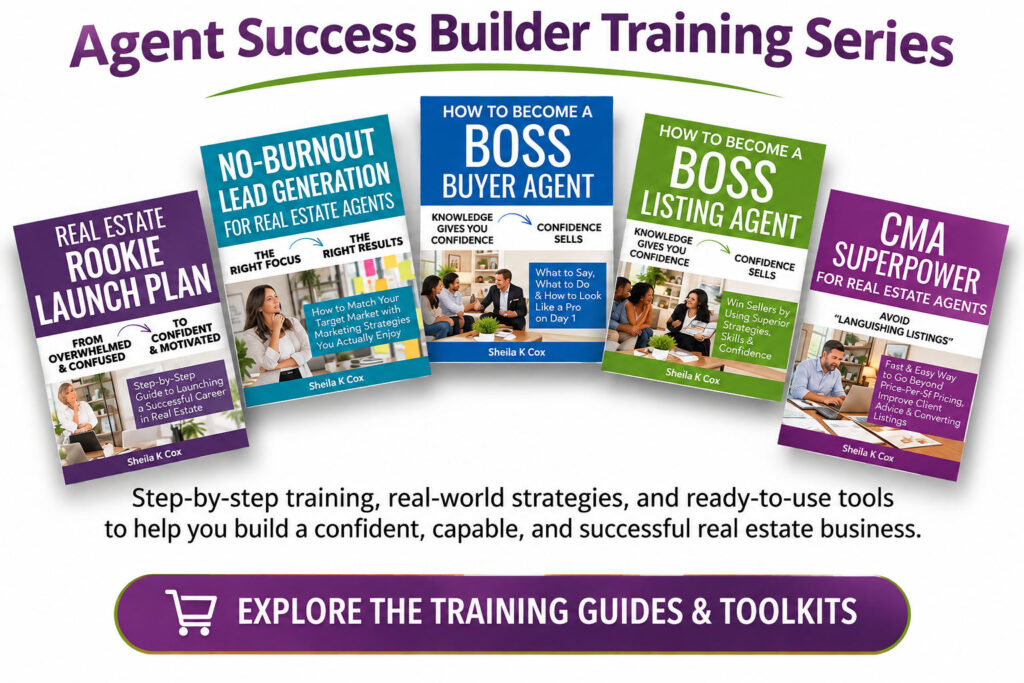
Ready to take your real estate career to the next level? Whether you’re just getting started or looking to strengthen your skills, the Agent Success Builder Training Series gives you the real-world knowledge, step-by-step guidance, and ready-to-use tools you need to build a successful real estate business.
Stop wasting time trying to figure everything out on your own. Explore our Training Guides and Digital Toolkits and find the resources that will help you become a more confident, capable, and successful real estate agent.