become the local real estate expert 2

How to Become the Local Real Estate Expert

Dominate Your Market with Local Expertise

Learning how to become the local real estate expert is important−here’s why. All real estate agents in your area (your competition) are selling the same products as you: the same houses and the same location. The key differentiator—the way you can set yourself apart from the pack—is your expertise in your product. It’s so obvious, yet this is probably the most overlooked aspect of your real estate training.

If you want to be a great real estate agent, you need to be a real estate expert in two areas:

  1. Your market area (location)
  2. Your product (residential housing)

So you can either choose to acquire this expertise very slowly over the next few years (like most real estate agents) or you can use The Easy Way to Become the Local Real Estate Expert guide and develop your expertise as quickly as possible.

CLICK TO DOWNLOAD

The sooner you become a product and market expert, the sooner you will succeed in this business. This is what the veteran real estate agents have that you don’t have. This is what will set you apart from your competition.

Acquiring this knowledge will give you the confidence you need to attract new clients. Plus, the information that you gather in this chapter will be used in the future as you promote yourself on social media.

Learn About Your City

Even if you have lived in your area a while, you may not know it as well as you need to as a real estate agent. While you don’t need to know all the in’s and out’s of your city just because you live there, clients will expect you to have in-depth knowledge regarding the city where you work. They will ask you about schools, taxes, amenities, parks, drive times, etc. If you can’t easily answer those questions, then it’s likely they will move onto a real estate agent who can do so.

To become the local real estate expert, take some time and fill-in the City Worksheet located in The Easy Way to Become the Local Real Estate Expert guide. That worksheet includes the must-know information that clients expect you to be very familiar with.

You can look up most of this information on the Internet. Good places to start include:

  • City’s .gov website
  • Chamber of Commerce website
  • Google maps
  • School district website
  • Greatschools.org

DOWNLOAD The Easy Way to Become the Local Real Estate Expert

Learn About the Public Schools in Your Area

Clients will also expect you to know a lot about the local schools in your area.

What is the name of the local school district?

_____________________________________

Are there other school districts in your local area?

_____________________________________

How do these school districts compare? (Use schooldigger.com to get a comparison)

Check the school district websites in your area, and print copies of the school zone maps, one each for:

  • Elementary schools
  • Middle schools
  • High schools

If your area includes multiple school districts, collect the zoning maps for each district.

To become the local real estate expert, use www.Greatschools.org to make a list of the schools in your area and their ratings. Use a Word document with a table that will enable you to sort the list in various ways:

  • By Type (Elementary, Middle, High)
  • By Type, then Rating
  • Alphabetically

Once you know the ratings of the schools, handwrite those ratings on your printed school zone maps. Study the areas that have the highest-rated schools and the areas with the lowest-rated schools.

Learn About the Local Neighborhoods

Your primary market area may consist of single-family neighborhoods, high- and mid-rise condo buildings, or townhome complexes. To simplify things, they will all be referred to as “neighborhoods.”
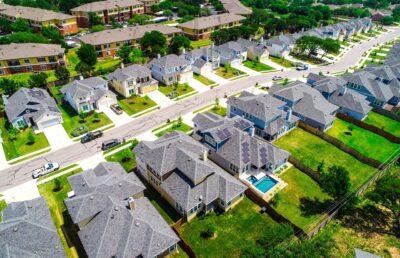
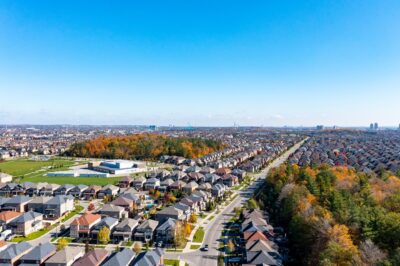
profitable real estate marketIf you don’t already know your area very well, use the How to Find a Profitable Target Market guide. Or you may be able to figure out the most popular neighborhoods in your primary area, by doing an Internet search for:

  • “Best places to live in YOURCITY”
  • “YOURCITY neighborhoods”
  • “New construction homes in YOURCITY”

New construction neighborhoods should be at the top of the list because they will have a lot of purchasing activity.

You can also look at local real estate agent websites and see how they are segmenting the primary market on their websites.

Once you know the popular neighborhoods in your area, you should do some Internet-based research to fill in a Neighborhood Worksheet for each of the top neighborhoods/buildings—one set of worksheets for each neighborhood/building. If you do one or two neighborhoods a week you will be the local real estate agent in no time!

DOWNLOAD The Easy Way to Become the Local Real Estate Expert

After you complete the City Worksheet and all the Neighborhood Worksheets that you need, use a three-ring binder and make a Neighborhood Notebook. Put the filled-in worksheets, summary pages, and builder information in the notebook. This is something that you can carry with you on tours.

Advice for Touring Your Area

You should drive your area and visit the various city and neighborhood amenities to get a first-hand view of them. You will be more comfortable showing clients homes in your area, if you know where everything is (schools, parks, hospitals, pools, golf courses, etc.) and if you have seen them, in-person, at least once.

There are two ways you can tour your area:

  • All at once on 3-5 day tour
  • One neighborhood/building per week

All At Once Tour

After you fill in your worksheets and are ready to tour your area, print a Google map and write the various places that you want to visit on the map. Then plan the order you will tour those places.

become the local real estate expertPlan three to five days in good weather to go on your tour (depending on the size of the city and the number of neighborhoods you are touring). Take photos and video clips of each neighborhood. For video clips, just pan your camera from left to right for each item (clubhouse, swimming pool, tennis courts, etc.) creating 5-15 second video clips. You can then use your photos and video clips for interesting social media posts later on.

Weekly Tour

You don’t have to tour your area all at once. You can visit just one or two neighborhoods/buildings per week. You still need to gather the same information, photos, and video clips as listed above, but you will only do one or two neighborhoods at a time. If you are a part-timer, it may be easier for you to do weekly tours rather than touring the entire area all day for 2-3 days.

About Touring Individual Houses

A lot of real estate training books and courses, including your broker training, will tell you to tour 10-20 homes per week. This is not efficient or effective. Individual houses are here today and sold tomorrow, but the amenities, parks, schools, etc. are here to stay, so focus on touring those places first. Being super-familiar with your neighborhoods will give you a lot of confidence when you are working with clients.

City Images to Collect

You should take photos and video clips when you are touring the area. Collect as many as possible but keep in mind that more can be added later.

For the best photos, try to tour the city on a sunny day in the spring or summer.

A video clip is usually only a 5 to 15 seconds video, either panning a scene from left to right, or starting zoomed in on the subject and then slowly zooming out.

There’s a helpful list of city images/video clips to collect in The Easy Way to Become the Local Real Estate Expert guide.

Neighborhood Images To Collect

You should also take photos and video clips for each of your top neighborhoods. To get the best photos, try to tour neighborhoods on sunny, non “trash days,” in the spring or summer.

There’s a helpful list of neighborhood images/video clips to collect in The Easy Way to Become the Local Real Estate Expert guide.

Learn About Home Construction

In addition to learning the local area to become the local real estate expert, you also need to be an expert in your product.

Real estate agents sell homes…that’s our product. It may be single-family homes, townhomes, farm and ranch properties, high-rise condos, but they are all homes.
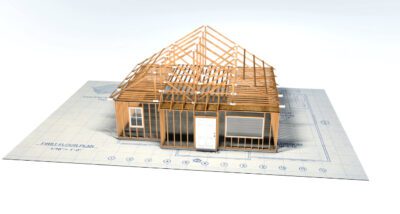
You should have at least intermediate knowledge of home construction, materials, systems, architectural details, and potential defects so that you can discuss them with clients when you are out showing houses or on listing appointments. The more knowledge you have, the more confidence you will project with clients, which builds your credibility with them and makes them want to work with you. No client wants to hire an agent who knows less about homes than they do.

Another reason that you need to know a lot about houses is so you can effectively manage the home inspection process, negotiate repairs, and prepare homes to go on the market to sell, etc.

Here are a few places to start learning about houses, but do some Internet searches to find more:

You can learn a lot of what you need to know by reading articles on the Internet and watching YouTube videos. You should visit home improvement stores and learn about materials and costs. You can purchase books on home construction, improvement, maintenance, and repairs. You should also tour model homes and ask builder’s sales agents to tell you about their features and benefits. If possible, ask a veteran agent in your office to go on a tour of a few homes in the area. Choose homes that have been on the market a long time…they probably have issues and defects that the veteran agent can point out to you and teach you what to look for (and avoid).

Another way to learn about home construction is to attend home inspections (once you start working with buyer clients) and listen to what inspectors have to say.

Use the checklist in The Easy Way to Become the Local Real Estate Expert guide to keep track of what you need to know about home construction. You want to know the common terms and understand the PROs and CONs, materials, common defects to watch out for, and price ranges for most of the following items. You should be able to confidently discuss these topics with your clients.

You don’t have to learn all these topics at once, but you should schedule time each week to learn about these items and become very knowledgeable about them. The sooner you know this information really well, the sooner you will project an image of confidence when working with clients.

As you go through the learning process, make bookmarks of helpful websites and articles and keep them organized so you can refer back to them when you create social media posts in the future. Whenever you see interesting graphics or photos, download the file, or capture a screenshot as a JPG file, so you can use those items on future social media posts. However, be careful of copyright infringement and always include the source (the URL address) of the information.

Overall, you’ve got to Know Your Product!
People don’t want to hire real estate amateurs; they want to hire real estate experts. Selling real estate is not just about knowing the laws and contracts. You must be knowledgeable about home materials and construction if you want to be a successful real estate agent.


CLICK TO DOWNLOAD

DOWNLOAD THIS GUIDE

Master Your Market and Stand Out With HyperLocal Expertise

Use Local Knowledge to Attract Clients and Close More Deals

If you’re not known as the expert in your market, you’re losing business to someone who is. Buyers and sellers want to work with agents who know the area inside and out—not just someone with a license.

This guide helps you master everything from local amenities and school ratings to sales data, builders, and commute times—so you’re never caught off guard in a client conversation or listing appointment.



choosing profitable target market

Step-by-Step Process for Choosing a Profitable Target Market–From Guesswork to Paycheck

Critical Step for Your Real Estate Business

Choosing a profitable target market may be the most critical step of building your real estate business. However, most real estate agents just randomly pick an area that is close to where they live, spend lots of time and energy marketing in that area, only to fail at their efforts and wonder “what’s wrong with me?” or “what am I doing wrong?”

If you want to skip the hassle of wasting time and effort, then you must take some time to study your area and find out which possible markets will be profitable for you. Don’t base your marketing efforts on assumptions. Use the data in your MLS and do some real market analysis.

This process will help you with your HyperLocal expertise as well.

how to find profitable target market in real estate
CLICK TO DOWNLOAD

Once you find some possible target markets, make sure you narrow it down to the target market that is best for YOU (based on your unique characteristics). Also choose marketing activities that are a good match for your natural personality. This will help you actually ENJOY your marketing activities and prevent burnout.

Learn How to Use Your MLS First

Before you can study sales data in your local market, you have to know how to use the MLS software. Sign up for your MLS training classes as soon as possible. Take all the classes available: basic and advanced. Take online tutorials (if available). You really should be a PRO at using your MLS—it’s one of the best (and exclusive) tools we have as real estate agents. The information contained in the MLS is what gives you a key differentiator in your market place.

When you take your classes, make sure you learn the skills listed below.

  • Search by geographical area: by city, ZIP Code, subdivision, building, etc.
  • Search an area by using a mapping tool (if available with your MLS)
  • Obtain sales statistics for a geographical area within a specific time range (6 mths, 1 year, 5 years, etc.):
    • Number of Actives on the market
    • Number of Solds
    • Cumulative Days on Market
    • Median sales price
    • Lowest sales price
    • Highest sales price
    • Median price/sf
  • Create charts and graphs for Stats (if available with your MLS) for various market areas (city, ZIP Code, subdivision, building, etc.)
    • Five- or ten-year sales price trends
    • CDOM trends
    • Quantity Sold trends
  • Create custom searches for home buyers and set up automatic notification system for them (if available)
  • Print a map of a set of homes you want to see on a home tour
  • Print information sheets for buyers, per house (for home tours)
  • Print information sheets for agents, per house (for home tours)
  • Access the tax records for a specific owner’s name or address
  • Access lot details about a specific home, including flood zones (if available)

Study Your Primary Market: Area & Property Type

Understand How Your Local Market is Segmented

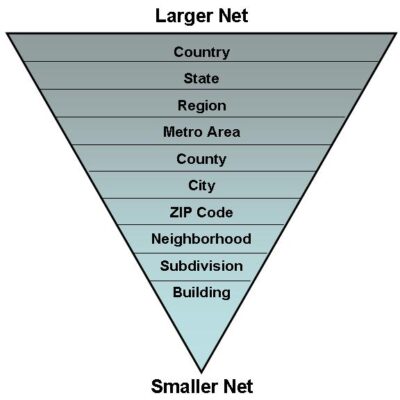
find a profitable target marketWhen you sell real estate, you are selling both a location and a home. Real estate is associated with land, and land is divided into countries, states, counties, cities, neighborhoods, ZIP Codes, etc. Then on that land, there are different types of homes for sale or lease, such as single-family homes, townhomes, high rise condos, rentals, etc. Every area is different. You probably won’t have a lot of Country Homes & Acreage properties in downtown Los Angeles, and you may not find any High-Rise Buildings in Tupelo, Mississippi.

Your MLS will be set up to search for homes by type, including some or all of the following:

  • Single Family Homes
  • Townhomes/Condos
  • Country Homes & Acreage
  • Farms & Ranches
  • Mid- and High-Rise Buildings
  • Rentals
  • Empty Lots

Your MLS will segment the area in multiple ways, with multiple fields:

  • City
  • ZIP Code
  • County
  • School District
  • Subdivision
  • Master Planned Community (Neighborhood)
  • Geo Market Area
  • Area
  • Legal Subdivision

Regardless if it’s in a neighborhood, a building, or a townhome community, all properties have a Subdivision field in the MLS. They will also have a Legal Subdivision field that is more exact. Get to know how agents list homes in your area on the MLS…it can be “tricky” for some neighborhoods which may also be part of a Master Planned Community field.

There are multiple ways to segment a local market, depending on the type of homes you want to sell and the area in which they are located:

  • Primary Market: Large geographical area (such as city or ZIP Code) plus type of home (single-family, high-rise condo, townhome, etc.). Example: Single-family homes in Tulsa, OK
  • Secondary Market: Specific neighborhoods, high-rise buildings, or condo complexes in your primary market. Example: The River Oaks, Garden Oaks, and Water Gardens neighborhoods in Dallas, TX or all Inner-Loop high rise buildings in Houston, TX
  • Farm Area: One specific neighborhood, building, or complex in your secondary market. Example: The Continental High Rise Building in Atlanta, GA
  • Niche Market: One specific type of client or home such as First-Time Home Buyers or Waterfront Homes in your primary market. Example: Golf course homes in Palm Spring, FL


Define Your Primary Market

A primary market is usually an entire city or ZIP Code. However, in metropolitan areas and very large cities, it may be only a specific portion of the city (such as several ZIP Codes within the city). In rural areas that are not densely populated, the primary market may be an entire county or region. In a small state like Rhode Island, the primary market could be the entire state.

In what type of primary market will you work and serve? (check the one that applies)

___ Metropolitan – several areas or ZIP Codes within metropolitan area

___ Urban – large city

___ Suburban – town or city on the “skirts” of a larger city or metro area

___ Rural – country area outside of a city or suburb

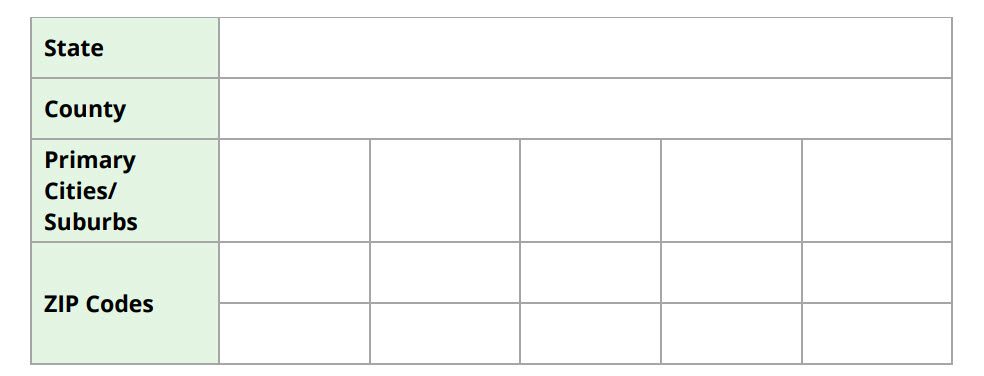
Fill-in the following table with information on your primary market…the primary area in which you sell houses. If you serve only one city then you may have only one ZIP Code.

You can do an Internet search for “zip code map for YOURCITY” and then click Images to find and print a ZIP Code map for your area. Keep the map handy.

What types of homes are available in your primary market? (check all that apply)

___ Single-family

___ Multi-family

___ Townhomes

___ High- and mid-rise condos

___ Farm and Ranch

___ Country Homes with Acreage

___ Other: ____________________

Different types of homes have different characteristics. Selling high-rise condos is different from selling single-family homes, which is different from selling farm and ranch properties. To generate the most leads, you should try to focus on the predominant type of home in your primary area (unless you want to focus on a niche).

During your first year, learn everything you can about the predominant type of home in your area. Become an expert in that type of housing. Learn the INs and OUTs of buying, selling, and living in that type of property. Have a list of home inspectors for that type of property. Your clients are going to rely on you to help them buy and sell houses, so you need some expertise in the type of product you are selling.

Study Sales Data in Your Primary Market

Use the How to Find a Profitable Target Market worksheets, and your MLS, to study your primary market based on sales data from the past 6 mths (for large areas with many sales) or 12 months (for smaller areas with fewer sales). This will give you a general understanding of your area. It will also help you to know which areas are the most and least profitable, so you don’t waste time focusing on unprofitable markets.

You do not have to analyze every type of property. If you don’t plan to handle rentals, then don’t analyze that column. If you don’t have Country Homes and Acreage, then don’t waste time on that category either. However, it never hurts to have a complete understanding on what types of properties are selling best in your area, and which ZIP Codes are selling the most.

What types of property are predominant in your area? Which areas have the most sales? Focus on no more than two property types on the next page.

Study Top One or Two Types of Property in Each ZIP Code

profitable real estate marketSometimes it is very obvious that there is only one property type with the most sales in your area. However, there could be two or more property types that have similar sales activity. Use the How to Find a Profitable Target Market worksheets to look more closely at the sales data for the top two types of property (single family, townhome, high-rise, etc.). Your objective is to find the one most profitable property type and area to focus your business during your first year.

Which ZIP Codes have the most sales? Start narrowing your focus to find a “hot” target market, but make sure it has enough activity to meet your business goals.

Study Your Secondary Market: Top Neighborhoods or Buildings

A secondary market is the top-selling neighborhoods/buildings within your primary area. Once you know the type of property and the area (such as ZIP Code) that you want to focus on, then use your MLS software to find the top-selling neighborhoods/buildings in that area.

Using your MLS, search for Solds in your chosen city or ZIP Code(s), over the past 6 to 12 months (depending on the size of the area), and then sort the MLS results by Subdivision. Then scroll through the results, and write down the names of all the neighborhoods/buildings that seem to have a high quantity of sales on the table on the next page. This will create a list of subdivisions (neighborhoods/buildings) for you to investigate in order to find the top-selling neighborhoods in your area.

Study Top-Selling Neighborhoods/Buildings

Scroll through the MLS results for Solds in the past 6 to 12 months (depending on the number of sales available in that period), for the type of property and area (city or ZIP code) that you plan to focus, and look for Subdivisions with the most sales. Write the names on the How to Find a Profitable Target Market worksheets.

Use your MLS to collect the stats for each subdivision, and write that information on the worksheets. Then copy the applicable table to a Word document so that you can sort the table in different ways (see below) to identify the top neighborhoods/buildings in your area.

Identify Top Neighborhoods/Buildings

Find the top five neighborhoods/buildings in each of the following categories:

  • Most Popular (by number of sales)
  • Luxury (by median sales price, high to low)
  • Most affordable (by median sales price, low to high)
  • Fastest Selling (by CDOM, low to high)
  • Lowest amount of Inventory (by Months of Inventory, low to high)

Think about the results and understand why. Why are certain neighborhoods the fastest selling? Why do certain neighborhoods have the lowest inventory?

– Schools? – Location? – New Construction? – Price? – Age? – View?

For help, discuss these things with a mentor or experienced agent in your office.

Evaluate Possible Farm Areas

Some agents, not all, choose to “farm” a specific neighborhood as their marketing strategy. A farm area is one specific neighborhood or building in your secondary market. Targeting a specific neighborhood/building can be a lot easier than targeting an entire city or ZIP code. It is much easier to become the “hyperlocal real estate expert” for a farm area than for a large city.

real estate target market analysisA farm area needs to be small enough that you can affordably advertise in it on a consistent basis (monthly advertising is important), but has enough active sales to be worth your attention. It should be a neighborhood/building that you will enjoy working and one that is a good match for you demographically.
If it is a very large neighborhood or building, then you may want to start your direct mail focus on one section of about 100-200 homes first and then expand as your budget grows. Expect to spend at least $300/mth on direct mail and other advertising in the beginning of your career. Remember that it may take 10+ months of consistent, monthly advertising until you see results.

Now that you have analyzed your secondary market, do you see any specific neighborhoods/buildings that may be a good match for you to farm? Top-selling neighborhoods are often a good choice, but it depends on where you want to focus your efforts.

Possible Farm areas:

Now transfer the data from the previous worksheet for your possible farm areas on p. 7 of the How to Find a Profitable Target Market worksheets. Does one neighborhood stand out as the most likely to be profitable?

Evaluate Possible Niche Markets

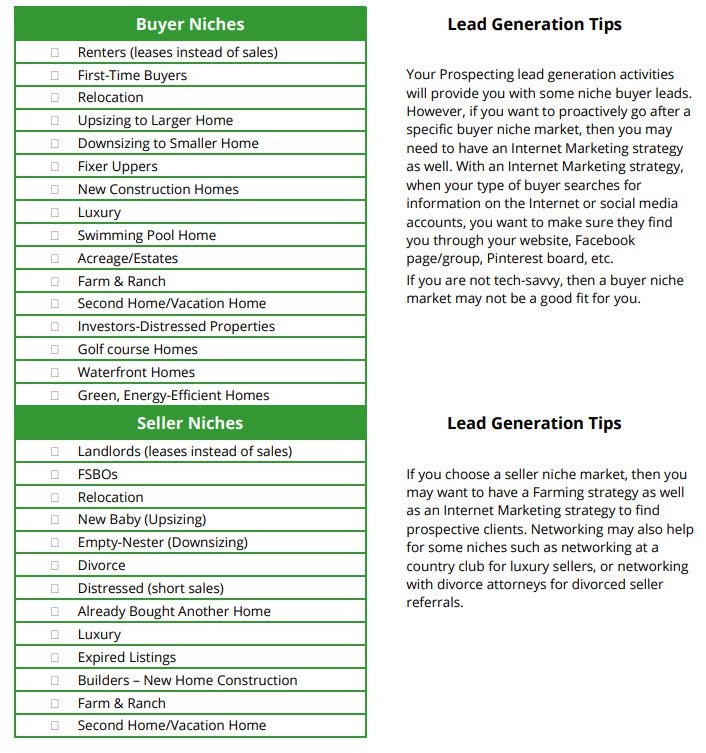
Active, top-selling neighborhoods or buildings are usually the best type of target markets in real estate. However, some real estate agents may choose a “niche” market as their target market. A niche market is a specific type of home buyer or seller.

Just like farming a geographical area, targeting a specific niche can be a lot easier than targeting an entire primary market or even a secondary market. However, you need to make sure that your niche is large enough (number of Solds) to be profitable.

When selecting a niche market, you should consider your personal passions and hobbies, but also make sure that the niche exists in your market. If you love playing golf, then golf course homes may be a fun niche for you…unless you live in the middle of a large city where there are no golf course homes available. Or, if you live in a predominantly Oil & Gas area, then energy-efficient Greenies may not be a good niche market for you…even if it is one of your passions. And if you live in a retirement area with very high sales prices, then first-time home buyers may not be a good focus for you, even if you like that niche.

When choosing a niche, make sure:

  • Your niche is available in your market area.
  • You have commonalities with your chosen niche.
  • Your niche is big enough for you to meet your financial goals.
  • Your niche is a good match for you, given the demographics of your niche.
  • You have the right skillset to generate leads for your chosen niche.

The following lists show common types of real estate niches. Check only those that you have something in common and only if they exist in your market. (If your market is downtown Atlanta, then don’t choose farm and ranch.) Keep in mind that you will need the right skillset to advertise to the type of niche market that you choose.

Niche Market Summary

You can only use the MLS to analyze some types of niches, not all of them. There is no MLS field for “first time home buyer” but there are fields for: Private Pool, New Construction Home, Golf Course Lot, etc. Use p. 9 on the How to Find a Profitable Target Market worksheets to get an idea of what’s available in your market, so you can evaluate if it may be a profitable niche.

Select a Profitable Target Market

Once you understand your market, then you should select a “target market” to focus your marketing efforts on. Of course, you will help clients buy and sell anywhere in your primary market, but that area may be too big (and expensive) to “target” your advertising efforts…especially your first year. So it is wise to select a secondary market, farm area, or niche market to set as your “target market.”

define-market-areaFor example, your target market may be:

  • One favorite neighborhood/building/subdivision (farm area)

–Or–

  • Top 5-10 selling neighborhoods in the city (secondary market)

–Or–

  • Top 5-10 selling high-rise condo buildings in a ZIP Code (secondary market)

–Or–

  • One niche market in the city (golf course homes)

–Or–

  • A combination…one farm area and one niche market

The size of your target market is important. It must be active enough (with a high number of sales) to provide enough sales in order for you to reach your business goals, but small enough for you to cover effectively. If you live in a metropolitan area, such as Chicago, you probably can’t cover the entire metro area, so you will need to “drill-down” to a secondary market, niche market, or farm area. However, if you live in a rural area, you may have to cover several small towns in your region, or an entire county, in order to meet your income goals.

Write Down Three Potential Target Markets

List the top three possible target markets for you on p. 10 of the How to Find a Profitable Target Market worksheets.

Do the Possible Target Markets Have Enough Sales?

Before you waste time focusing on a specific target market, double-check to make sure it has enough sales to support your income goals.

*Market Share Percentage: This varies depending on how much market share you think you can obtain in the neighborhood. If you think you can get 20 percent market share, then multiply the number of homes sold in that market per year by .2 (20 percent), and make sure the total is greater or equal to your goal for the number of homes you want to sell each year.

If a potential target market does not have enough annual sales to support your business goals, then you should either select a different target market or combine several neighborhoods in your target market (such as the “Top Ten Neighborhoods in YOURCITY”).

Are You a Good Match for the Target Market?

It is often said in real estate that people want to work with people they “know, like, and trust.” The more two people have in common, the more likely they will “like and trust” each other. So it is important for real estate agents to focus on markets that consist of people similar to them. For example, if you are a single, 20 year old, driving a 10 year old beat-up car, with only a high-school education, then you may have a hard time getting affluent, well-educated couples living in luxury neighborhoods and driving luxury cars to hire you. Or if you are a 60 year old who has a hard time with technology and hates to text or participate on social media, then you may not get hired by many Millennial first-time home buyers.

To make your life easier, and your career more successful, you must double-check yourself with your target market. If you are a mis-match to your chosen market, then select a different target market or discover ways to overcome the obstacles that you will face.

Research the demographics of your potential target markets and complete the table on p. 11 of the How to Find a Profitable Target Market worksheets. Some of this information may be difficult or impossible to obtain at a neighborhood or niche level, but the thought process is very helpful.

Your Target Market: ___________________________________________

Summary

Selecting the right target market is one of the most important steps in building a successful real estate business. Without the right target market, you are likely to spin your wheels, waste time, and waste money and then wonder “What’s wrong with me?” when your marketing activities don’t work.

Taking a careful study of your primary and secondary markets, as well as possible niche markets, will enable you to choose a target market that will be profitable for your business. Double-checking to make sure that there are enough sales in the target market to meet your business goals is another way to ensure that you don’t waste time on the wrong market.

Finally, it’s important to match both your target market and your marketing activities to YOUR unique personality. This will help you be more effective at marketing your business, since most people want to do business “with people they know like, and trust.” Plus, choosing the marketing activities that are a match for your personality will help prevent burnout and make it easier for you to enjoy your lead generation efforts.


how to find profitable target market in real estate
CLICK TO DOWNLOAD

DOWNLOAD WORKSHEETS

Zero in On the Right Area – Dominate Your Local Real Estate Market

Too many new agents jump into the business without a clear strategy—and end up spinning their wheels in areas with little activity or profit potential. This guide changes that.

Go through the step-by-step process with the worksheets in this guide and you’ll find the perfect target market for YOU.